
 EN
EN
 AR
AR DA
DA NL
NL FI
FI FR
FR DE
DE EL
EL HI
HI IT
IT JA
JA KO
KO NO
NO PL
PL PT
PT RU
RU ES
ES SV
SV TL
TL IW
IW ID
ID VI
VI HU
HU TH
TH TR
TR MS
MS GA
GA LO
LO MY
MY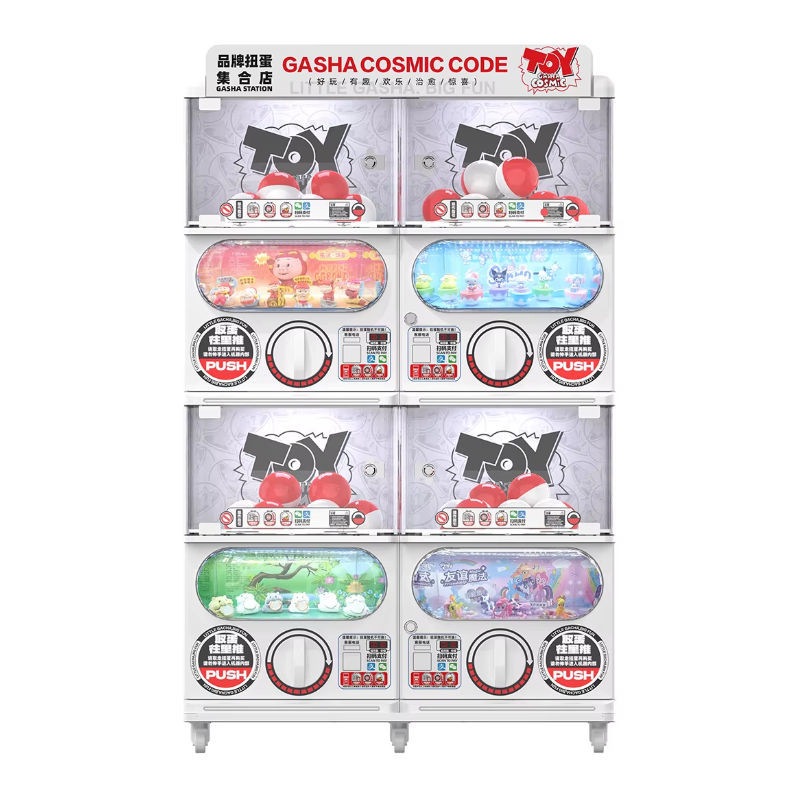
Core Durability Metrics for Capsule Vending Machine Investment
Cycle Count Thresholds: Defining 'Heavy Use' for Public Venues
Durability is absolutely essential for equipment used in public spaces. What counts as heavy usage? Think around 1500 operations per day in places like train stations, maybe even reaching 2000 times daily at busy theme parks. For something to last reliably, it needs to handle roughly half a million full cycles before any parts start showing wear signs. This isn't just guesswork either; there's actually an international standard called ISO 23771 that tests this stuff under pressure conditions. When products don't meet these requirements, businesses face serious problems down the road. Maintenance bills jump by about 40% in the first year alone, plus unexpected breakdowns happen right when customers are flowing in during those crucial peak periods. Nobody wants their machines giving out while hundreds of people wait in line.
Jam Rate and Actuator Lifespan: Key Predictors of ROI in High-Traffic Locations
Jam rates above 3% directly undermine profitability: each jam incurs an average $18/hour revenue loss during peak operations. Equally decisive is actuator lifespan—premium models achieve 800,000 cycles versus 300,000 in economy units. Machines with optimized actuators deliver 22% higher five-year ROI by minimizing service interventions and downtime.
Accelerated Testing Protocols to Simulate 3+ Years of Public Deployment
Validating long-term durability requires compressing years of real-world wear into controlled, predictive lab environments. Industry-standard accelerated aging protocols apply elevated mechanical, thermal, and usage stress to forecast field performance with high fidelity.
Designing Realistic Load Scenarios: 2,000 Cycles/Day — 30 Days
The method we use has been proven effective through simulation that mimics three full years of actual use (with equipment running at double capacity) by going through 60 thousand operational cycles within thirty days straight. Keeping this kind of continuous workload puts real strain on different parts of the machine, showing where weaknesses develop over time in things like the moving parts, money handling mechanisms, and gears. When we run tests under controlled temperatures around 55 degrees Celsius following the guidelines from Nelson Labs back in 2023, it speeds up how fast materials age. What takes nature 36 months to do naturally gets compressed into only 12 short weeks of intense testing conditions combining heat exposure with constant movement stresses.
From Time-Based to Usage-Based Validation: Aligning Tests with Capsule Vending Machine Investment Realities
Time-based assessments misrepresent how capsule vending machines degrade. Usage-based validation tracks what matters operationally:
- Cycle-driven failure rates, such as actuator lifespan per 100,000 operations
- Jam probability under sequential peak-load batches (e.g., 500 cycles/hour for 4 hours)
- Material fatigue curves, measured after 50,000+ cycles
This approach yields actionable ROI metrics—including maintenance cost per 10,000 cycles—enabling operators to make confident, data-backed investment decisions.
Failure Mode Analysis: Identifying and Mitigating Top Field Risks
Proactive failure analysis protects capsule vending machine investment in high-traffic settings. By mapping recurring breakdown patterns, operators reduce costly downtime and extend equipment life.
Coin Mechanism—Gear Interface Jamming (68% of Failures) and Root-Cause Engineering
Gear jamming at the coin-mechanism interface accounts for 68% of field failures. FMEA-based root-cause analysis identifies two primary contributors: misalignment from repeated coin impact and particulate buildup in gear teeth. Mitigation strategies—including tapered gear profiles and self-clearing tooth geometries—reduce jams by 40% in simulated 2,000-cycle/day testing.
Material Selection Impact: ABS vs. POM Gear Trials Under Sustained Load
Material choice critically influences long-term reliability under continuous torque loading:
| Material | Deformation Rate (After 500k Cycles) | Maintenance Frequency |
|---|---|---|
| ABS | 0.8 mm/month | Every 3 months |
| POM | 0.2 mm/month | Annually |
Polyoxymethylene (POM) gears maintain dimensional stability under loads three times greater than ABS equivalents, extending service intervals by 300%. That translates directly to lower labor costs, fewer parts replacements, and stronger ROI across public deployments.
Standardized Mechanical Stress and Impact Resistance Validation
Real mechanical resilience needs actual proof, not just marketing promises. Industry professionals rely on established benchmarks like ISO 6272 when evaluating how well products hold up against impacts (think about what happens after those inevitable drops). There's also ASTM G99 which looks at how surfaces handle constant friction from things like coins bouncing around inside machines. Why does this matter? Because equipment installed in public spaces gets abused in all sorts of ways we can't predict ahead of time – people kick them accidentally, kids might try to break them deliberately. Look at areas where stress builds up most, such as coin channels or gears working together constantly. When manufacturers skip proper testing here, maintenance bills tend to jump by about 40%. Companies that stick to these standards build mechanisms capable of handling pressures over 15 kg per square centimeter. This means fewer breakdowns down the road and turns vague talk about durability into something tangible operators can actually measure when calculating return on investment.
FAQ
What is considered 'heavy use' for capsule vending machines in public venues?
Heavy use is defined as approximately 1500 operations per day in places like train stations, rising to potentially 2000 operations daily in extremely busy locations like theme parks.
What are the consequences of high jam rates in vending machines?
High jam rates, specifically those exceeding 3%, can lead to significant revenue loss, averaging $18/hour during peak operations. They also reduce the machine's overall return on investment (ROI).
How does usage-based validation differ from time-based validation?
Usage-based validation focuses on actual operational metrics, such as cycle-driven failure rates, jam probability, and material fatigue curves, offering a more accurate prediction of machine degradation compared to time-based assessments.
Why is material selection crucial for vending machine durability?
Material selection, such as choosing between ABS and POM for gears, impacts the long-term reliability and maintenance frequency of the machine. POM gears, for example, offer greater stability and reduced maintenance compared to ABS.